
General Questions
1.
Q:
What is Pillar Two Portal?
A:
Pillar Two Portal is a system designated by the Commissioner of Inland Revenue under Part 4AA of the Inland Revenue Ordinance (Cap. 112) ("the Ordinance") for Part 4AA entities to submit top-up tax notifications, file top-up tax returns to the Inland Revenue Department ("the Department"), and view and/or download top-up tax assessments issued by the Department. The Pillar Two Portal is an extended part of the Business Tax Portal ("BTP"). After registration with BTP, Part 4AA entities can access the Pillar Two Portal directly from the BTP.
2.
Q:
Should the Part 4AA entity register for a Pillar Two Account in order to access to the Pillar Two Portal?
A:
Separate registration for a Pillar Two Account is not required. Business Tax Portal ("BTP") Administrators of the Part 4AA entity / Authorized Users who are assigned to handle Pillar Two Matters on behalf of the Part 4AA entity can access the Pillar Two Portal directly from the BTP.
For User Guides and e-Demos about the access of Pillar Two Portal from the BTP, please visit the Pillar Two Portal Resource Centre Page.
3.
Q:
Can a Part 4AA entity engage a service provider for top-up tax reporting purposes and what matters can the service provider handle?
A:
Yes. A Part 4AA entity can engage a service provider to handle all matters under the Pillar Two Portal through the Business Tax Portal ("BTP") and should notify the Department of such engagement when the Part 4AA entity sets up or updates its profile of the BTP Business Account. The designated service provider can engage the client under the Tax Representative Portal and access the Pillar Two Portal directly.
4.
Q:
A:
You have to register for a Tax Representative Portal ("TRP") Business Account. Before registering for a TRP Business Account, you must have a registered Business Tax Portal ("BTP") Business Account with BTP Administrator(s) appointed. After registration with TRP, you can engage the client for handling Pillar Two matters and access the Pillar Two Portal directly.
For User Guides and e-Demos about the access of Pillar Two Portal from the TRP, please visit the Pillar Two Portal Resource Centre Page.
5.
Q:
I am the person who acts for, or is responsible for the management of the Part 4AA entity ("PRM"), that is not a corporation, under section 36(1) of Schedule 63 to the Ordinance. How can I access the Pillar Two Portal?
A:
First of all, the Part 4AA entity should provide details of its PRM through the Business Tax Portal ("BTP") when the Part 4AA entity sets up or updates its profile of the BTP Business Account.
For an individual PRM, you can access the Pillar Two Portal through the Part 4AA entity’s BTP Business Account directly.
For a corporate PRM, please refer FAQ 4 above.
6.
Q:
Will there be user guides / guiding screens on how to access the Pillar Two Portal?
A:
Yes, please visit the Pillar Two Portal Resource Centre Page for the User Guides and e-Demos.
7.
Q:
What should I do if the Part 4AA entity does not have a Business Registration Number ("BRN") to register for a BTP Business Account?
A:
To register a Business Account under Business Tax Portal (“BTP”), the responsible person performing the registration is required to input, among others, the BRN of the Part 4AA entity. In general, a Part 4AA entity should have a BRN if it carries on business in Hong Kong. If the Part 4AA entity currently does not have a BRN but has the obligations to apply for a business registration certificate, it should approach the Business Registration Office of the Department directly to complete business registration procedures before performing any online registration of the BTP Business Account. If the Part 4AA entity is not carrying on any business in Hong Kong but wishes to register a BTP Business Account to fulfill its reporting obligations, it should write to IRD via beps2.0@ird.gov.hk to request for a Business Registration Number Equivalent ("BRNE"), which will serve the function of the BRN for the purpose of registration with the BTP, by providing the following information:
- the reason why the Part 4AA entity is not required to apply for a business registration certificate in Hong Kong;
- name and Hong Kong Identity Card Number of the responsible person of the Part 4AA entity; and
- whether the Part 4AA entity is a corporation or not.
8.
Q:
Can a Part 4AA entity authorize a tax representative for the purposes of global minimum tax and Hong Kong minimum top-up tax and what matters can the authorized representative handle?
A:
Yes. Part 4AA entity can authorize a tax representative to handle Pillar Two matters through the Business Tax Portal ("BTP") and notify the Department of such authorization when the Part 4AA entity sets up or updates its profile of the BTP Business Account. The designated tax representative can, through the Tax Representative Portal ("TRP"), make enquiries relating to Pillar Two matters, and lodge objections against top-up tax assessments on behalf of the Part 4AA entity. Please also refer to FAQ 9 below.
9.
Q:
A Part 4AA entity has authorized me as its tax representative to handle Pillar Two matters when it set up its account profile. Can I access the Pillar Two Portal and submit a top-up tax notification/top-up tax return for the Part 4AA entity?
A:
A tax representative, if not engaged as a service provider of the Part 4AA entity under section 13 of Schedule 63 to the Ordinance, is not allowed to file a top-up tax notification/top-up tax return on behalf of its client. However, the tax representative can view the top-up tax notification/top-up tax return already filed under the Pillar Two Portal, make enquiries and lodge objections against top-up tax assessments under the Tax Representative Portal.
10.
Q:
How does the Pillar Two Portal authenticate the identity of the person conducting transactions under the Pillar Two Portal?
A:
For conducting transactions under the Pillar Two Portal, such as submission of a top-up tax notification and filing of a top-up tax return, the Part 4AA entity, service provider or person managing the non-corporate Part 4AA entity is required to use an e-Cert (Organisational) with AEOI Functions for authentication. For more information about e-Cert (Organisational) with AEOI Functions, please click here to visit the website of the Hongkong Post Certification Authority.
11.
Q:
I am a holder of an e-Cert (Personal). Can I use that digital certificate for authentication under the Pillar Two Portal for the Part 4AA entity?
A:
No. An e-Cert (Organisational) with AEOI Functions must be used. The e-Cert (Personal) cannot be used for authentication under the Pillar Two Portal for the Part 4AA entity. Each authorized person, when conducting transactions under the Pillar Two Portal, must hold the relevant organisation’s e-Cert (Organisational) with AEOI Functions issued by the Hongkong Post Certification Authority.
12.
Q:
The Part 4AA entity is an existing subscriber of an e-Cert (Organisational). Can that digital certificate be used for authentication under the Pillar Two Portal for the Part 4AA entity?
A:
No. An e-Cert (Organisational) with AEOI Functions must be used. An e-Cert (Organisational) is not accepted by the Pillar Two Portal for authentication. The Part 4AA entity may choose to add the new feature of AEOI functions when renewing the existing certificate. For further details of the procedures and documents required, please click here to visit the website of the Hongkong Post Certification Authority.
13.
Q:
The Part 4AA entity has subscribed an e-Cert (Organisational) with AEOI Functions for submitting CbC Return to the CbC Reporting Portal. Can that digital certificate be used for authentication under the Pillar Two Portal for the Part 4AA entity?
A:
Yes. The Part 4AA entity can use the same e-Cert (Organisational) with AEOI Functions for authentication under the Pillar Two Portal. It is not required to apply for another digital certificate.
14.
Q:
What should I do if I forgot the password of my e-Cert (Organisational) with AEOI Functions?
A:
In case you forgot your password, you are recommended to revoke your e-Cert (Organisational) with AEOI Functions immediately and apply for a new one. For more details, please contact the Hongkong Post Certification Authority direct.
Filing of Top-up Tax Notification
15.
Q:
Which entity is required to file a top-up tax notification for a fiscal year?
A:
A Part 4AA entity of an in-scope MNE group for a fiscal year is required to file top-up tax notifications for that year. As defined in section 1(1) of Schedule 63 to the Inland Revenue Ordinance (Cap. 112), a Part 4AA entity, in relation to an MNE group, means ─
(a) a HK constituent entity;
(b) a HK standalone JV;
(c) a HK member of a JV group; or
(d) a Part 4AA stateless constituent entity.
16.
Q:
Can an in-scope MNE group appoint one entity to file a top-up tax notification on behalf of the group?
A:
Yes. If a HK constituent entity ("HKCE") has filed a top-up tax notification in respect of an in-scope MNE group for a fiscal year and identified itself as the ultimate parent entity, the designated filing entity, or the designated local entity of the group, other HKCEs of the group are not required to file top-up tax notifications for that year. Similarly, if a HK member of a JV group has filed a top-up tax notification in respect of a JV group for a fiscal year and identified itself as the designated local entity of the JV group of the in-scope MNE group, other HK members of the JV group are not required to file top-up tax notifications in respect of the same JV group of the MNE group for that year.
However, a HK standalone JV and a Part 4AA stateless constituent entity must file its own top-up tax notification.
17.
Q:
A HK member of a JV group of an in-scope MNE group is also a HK member of a JV group of another in-scope MNE group. Should the entity file a top-up tax notification in respect of each MNE group?
A:
Yes. A top-up tax notification should be filed in respect of each MNE group.
18.
Q:
How can a Notifying Entity file a top-up tax notification?
A:
The top-up tax notification should be filed through the Pillar Two Portal. For details, please refer to A Guide to Submit Top-up Tax Notification.
19.
Q:
Is there any registration requirement before a Notifying Entity can file a top-up tax notification?
A:
For identification and tax administration purposes, an MNE code is assigned to each in-scope MNE group and a JV code is assigned to each JV group or HK standalone JV.
When accessing a top-up tax notification under the Pillar Two Portal for completion and filing, a HK constituent entity or a Part 4AA stateless constituent entity will be required to provide the MNE code. In the case of a HK standalone JV or a HK member of a JV group of an in-scope MNE group, it will be required to provide the MNE code and JV code. To obtain an MNE code and / or JV code, an "Application for Group Code in respect of Multinational Enterprise Group, HK Standalone JV or JV Group" (Form IR1485) should be completed. To ensure timely submission of top-up tax notification, Notifying Entities are encouraged to register as early as possible.
20.
Q:
If an ultimate parent entity of an in-scope MNE group and / or a joint venture of a JV group is not located in Hong Kong and the jurisdiction in which it is located does not issue a Tax Identification Number, in completing Form IR1485, what should be inputted as "Business Registration Number / Tax Identification Number" in Item 4(b)(iii) under Part 2 and / or Item 2(c) under Part 3 of the form?
A:
Please input "NOTIN" in Item 4(b)(iii) under Part 2 and / or Item 2(c) under Part 3 of Form IR1485.
21.
Q:
When accessing a top-up tax notification under the Pillar Two Portal, the Notifying Entity has to input the Business Registration Number / Tax Identification Number ("TIN") of the Ultimate Parent Entity ("UPE") / Joint Venture ("JV"). If the UPE and / or the JV is not located in Hong Kong and the jurisdiction in which it is located has not issued a TIN to it, what should be inputted?
A:
"NOTIN" should be inputted as "Business Registration Number / Tax Identification Number of the Ultimate Parent Entity" and / or "Business Registration Number / Tax Identification Number of the Joint Venture".
22.
Q:
A Notifying Entity is required to provide particulars of all HK constituent entities / HK members of JV group of the in-scope MNE group in Part 3 of a top-up tax notification. How can the information be provided?
A:
In completing a top-up tax notification on the Pillar Two Portal, the Notifying Entity can provide details of all HK constituent entities or all HK members of the JV group by either online input or upload a CSV file. The CSV file should be prepared in advance, containing business registration numbers of the entities, and should be saved in UTF-8 ".csv" format. The system will reject the CSV file, which is not UTF-8 encoded. For details, please refer to A Guide to Submit Top-up Tax Notification.
23.
Q:
Can a Notifying Entity make any amendments to a top-up tax notification which has been submitted through the Pillar Two Portal?
A:
i. the list of Hong Kong constituent entities of the MNE group; or
ii. the list of Hong Kong members of the JV group.
General Filing Requirements
24.
Q:
What is a Top-up Tax Return?
A:
A Top-up Tax Return is an electronic return for reporting the information required for the administration and assessment of Hong Kong minimum top-up tax (HKMTT), income inclusion rule (IIR) top-up tax and, when the relevant provisions commence, undertaxed profits rule (UTPR) top-up tax. Where the GloBE information Return (GIR) is filed in Hong Kong, the GIR forms part of the Top-up Tax Return.
The Top-up Tax Return is separate from the Top-up Tax Notification. Filing a Notification does not discharge the obligation to file a Top-up Tax Return.
25.
Q:
Who is required to file a Top-up Tax Return?
A:
In principle, each Hong Kong constituent entity of an in-scope MNE Group is required to file a Top-up Tax Return for each Fiscal Year, subject to the group filing arrangements under Schedule 63 to the Inland Revenue Ordinance (IRO).
The filing requirements also apply correspondingly to:
- a Hong Kong standalone joint venture (JV);
- a Hong Kong member of a JV Group; and
- a Part 4AA stateless constituent entity.
26.
Q:
Can a Filing Entity submit a Top-up Tax Return in paper form?
A:
No. Pursuant to section 11(3)(a) of Schedule 63 to the IRO, a Top-up Tax Return must be filed in the form of an electronic record using a system designated by the Commissioner of Inland Revenue (Commissioner). The Pillar Two Portal is a system designated by the Commissioner for filing Top-up Tax Returns, as well as Top-up Tax Notifications.
27.
Q:
A:
Yes. Separate Returns are not required from the other Hong Kong constituent entities for a particular Fiscal Year where:
- group GloBE filing is effected in Hong Kong by the Hong Kong ultimate parent entity (UPE) or a Designated Filing Entity (DFE) for the Fiscal Year; or
- group local filing is effected by a Designated Local Entity (DLE) appointed by all the Hong Kong constituent entities for the Fiscal Year.
For a JV Group, one Hong Kong member may be appointed as the DLE to file the Return for the Hong Kong members of that JV Group. A Hong Kong standalone JV and a Part 4AA stateless constituent entity generally have their own filing obligations. However, the Hong Kong member of a JV Group, the Hong Kong standalone JV or the Part 4AA stateless constituent entity may be relieved from filing the GIR where it has declared in the Notification that the MNE Group’s GIR has been or will be filed:
- in Hong Kong by a Hong Kong constituent entity; or
- outside Hong Kong by the UPE or DFE in a jurisdiction with which an exchange mechanism is in place.
28.
Q:
There are more than one assessed subgroup within an in-scope MNE Group in Hong Kong. Can each of the assessed subgroups submit a Top-up Tax Return in respect of respective subgroup’s top-up tax liability?
A:
No. A Top-up Tax Return must report the tax information and top-up tax liabilities in respect of all Hong Kong constituent entities of the MNE Group for a Fiscal Year. However, separate Top-up Tax Return should be filed under the following circumstances:
- a Hong Kong Standalone JV or a Part 4AA stateless constituent entity should file its own Top-up Tax Return, and
- a Hong Kong member of a JV Group should file the Return for the JV Group as a whole.
In any case, Top-up Tax reporting calls for coordination among an MNE Group. The Filing Entity should obtain all necessary information from the group’s UPE or other entities so that it can comply with the filing requirements.
29.
Q:
How can a Part 4AA entity which is required to file a Top-up Tax Return obtain a Return for filing?
A:
The entity should file a Top-up Tax Notification using the Pillar Two Portal. User guides to access the Pillar Two Portal and submission of Top-up Tax Notification are available here. The Top-up Tax Return will be issued electronically to the entity through the Pillar Two Portal.
30.
Q:
All Hong Kong constituent entities of an MNE Group have appointed Entity A as the DLE while Entity A is the only entity within the MNE Group that has submitted a Top-up Tax Notification for a Fiscal Year. Can Entity B that is a Hong Kong constituent entity of the same MNE Group subsequently be appointed by all Hong Kong constituent entities as the DLE, instead of Entity A, to file a Top-up Tax Return for that Fiscal Year?
A:
Under section 5(1)(e) of Schedule 63 to the IRO, the Top-up Tax Notification reports whether group local filing is intended to be effected and, if so, the identity of the intended DLE. Group local filing is ultimately effected under section 8 if, by the filing deadline, the DLE files the Top-up Tax Return for the MNE Group.
The filing arrangements reported in the Top-up Tax Notification should be consistent with those ultimately adopted for the Top-up Tax Return. Where all the Hong Kong constituent entities subsequently decided to appoint Entity B, instead of entity A, as the DLE for filing the Top-up Tax Return, Entity A should notify the Inland Revenue Department (IRD) of the change either in writing or through the "Make a request / reply" service in its Business Account under the Business Tax Portal (BTP). Subsequently, Entity B should file the Top-up Tax Notification identifying itself as the DLE and stating that group local filing will be effected in Hong Kong through it. Then, Entity B can file the Top-up Tax Return via the Pillar Two Portal.
31.
Q:
What is the filing deadline of the Top-up Tax Return for a Fiscal Year?
A:
The ordinary filing deadline is 15 months after the end of the Fiscal Year. For the MNE Group’s transition year for filing purposes, the filing deadline is extended to 18 months after the end of the Fiscal Year.
The transition year for filing purposes is determined at the MNE Group level. It is the earliest Fiscal Year in which a constituent entity, JV or JV subsidiary of the MNE Group is subject to a qualified IIR, qualified UTPR in Hong Kong or another jurisdiction, or is subject to the HKMTT.
For this purpose, an entity is regarded as being "subject to" a rule if it falls within the scope of that rule, irrespective of whether any top-up tax is payable. For example, where a qualified IIR is applied by the MNE Group’s foreign parent entity from Fiscal Year 2024, Fiscal Year 2024 is the transition year for filing purposes even if no top-up tax is payable for that year. However, the application of a foreign QDMTT alone does not make a Fiscal Year to be the transition year for filing purposes.
32.
Q:
Is a Top-up Tax Return required to be filed if no top-up tax is payable?
A:
Yes. The absence of a top-up tax liability does not, by itself, relieve an entity of its obligation to file a Top-up Tax Return. A Return must still be filed unless the entity qualifies for an applicable group filing relief.
Where there is no HKMTT payable for the Reporting Fiscal Year, the Filing Entity must still report in the Top-up Tax Return the basis on which no HKTT liability arises. This may arise, for example, from the application of a safe harbour, an exclusion, the absence of net GloBE income or an effective tax rate of at least 15%.
33.
Q:
If all Hong Kong constituent entities of an in-scope MNE Group are Investment-related Entities, is any entity required to file a top-up tax return?
A:
Yes. Although an Investment-related Entity that is subject to Articles 7.4, 7.5 and 7.6 of the GloBE rules is not chargeable to the HKMTT, this exclusion does not relieve the entity from its filing obligations. Section 3(1) of Schedule 63 to the IRO requires every Hong Kong constituent entity of an in-scope MNE Group to file a top-up tax return for a Fiscal Year, unless group GloBE filing has been effected in Hong Kong under section 6 or group local filing has been effected under section 8 of that Schedule.
34.
Q:
Does a Filing Entity need to submit any supporting documents (e.g. financial statements and top-up tax computation supporting schedules) when filing the Top-up Tax Return?
A:
The supporting documents need not be submitted together with the Top-up Tax Return. They should be submitted for review upon request.
GIR Filing
35.
Q:
Must the GIR always be filed in Hong Kong?
A:
No. The GIR need not be filed in Hong Kong where the group GloBE filing has been effected outside Hong Kong. This requires, among other things, that:
- the GIR is filed by the UPE or DFE in another GloBE jurisdiction by the filing deadline of the Top-up Tax Return for the Fiscal Year;
- the GIR is filed in accordance with the laws or regulations of that jurisdiction; and
- an exchange mechanism is in place between that jurisdiction and Hong Kong.
The filing relief applies only to the GIR. The Return containing the relevant assessment triggering information must nevertheless be filed, unless the entity is eligible for another applicable group filing relief.
36.
Q:
If the UPE and the DFE of the in-scope MNE Group are not located in Hong Kong and Hong Kong cannot rely on the exchange mechanism to obtain the GIR for the group, what is the local filing requirement in relation to the GIR?
A:
In general, a Filing Entity that is not the UPE or the DFE of the in-scope MNE Group is only required to report the information that Hong Kong would have received pursuant to the exchange mechanism. According to the dissemination approach adopted by the OECD/G20 Inclusive Framework on Base Erosion and Profit Shifting, the GIR locally filed in Hong Kong should include:
- general information and the corporate structure of the in-scope MNE Group; and
- sections of the GIR that relate to the effective tax rate and top-up tax computation, allocation and attribution for Hong Kong in respect of which Hong Kong has taxing rights (including HKMTT and IIR top-up tax).
For more information regarding the dissemination approach, please refer to the standard template and the explanatory guidance of the GIR.
37.
Q:
If it was reported in the Top-up Tax Return that the GIR has been filed outside Hong Kong, what happens if the foreign competent authority does not transmit the GIR to Hong Kong?
A:
If the GIR is not received by the return exchange date as defined in section 7(4) of Schedule 63 to the IRO, the Commissioner may, by notice, require one or more Part 4AA entities to file the GIR directly in Hong Kong. In that case, the GIR must be filed by the later of:
- 60 days after the date of the notice; and
- the date specified in the notice.
38.
Q:
Can the GIR filing route be changed after the Top-up Tax Notification has been filed?
A:
Yes, but the change should be notified to the IRD before the Top-up Tax Return is submitted. For example, if the Notifying Entity originally declared in the Notification that the GIR would be filed outside Hong Kong but the group subsequently decides that the GIR will instead be filed in Hong Kong by that entity, the entity should inform the IRD in writing or through the "Make a Request / Reply" service in its BTP Business Account. The IRD will confirm the amendment, after which the entity may complete or submit the Top-up Tax Return.
39.
Q:
In what format must a GIR filed in Hong Kong be submitted?
A:
The GIR must be prepared using the OECD standard template and submitted in XML format. The preparation and submission of the GIR in Hong Kong should follow the OECD’s GIR XML Schema and XML Schema User Guide, together with the IRD’s Supplementary User Guide for Preparing the GIR.
The Filing Entity should retain a copy of the uploaded GIR data file. The file cannot be downloaded or retrieved from the Pillar Two Portal after it has been uploaded.
Completing the Return
40.
Q:
What should the Filing Entity do if pre-filled information shown in the Top-up Tax Return is incorrect?
A:
The Filing Entity must review and verify the accuracy of all pre-filled information before submitting the Return. Where any pre-filled information is incorrect, it should be amended through the appropriate channel before submission.
- information sourced from the BTP Business Account should be corrected by updating the relevant account profile;
- the list of Hong Kong constituent entities or Hong Kong members of a JV Group should be updated through the applicable Notification amendment function in the Pillar Two Portal; and
- other information sourced from the Notification or Pillar Two Portal may, where permitted, be amended directly in the Return. Where direct amendment is not available, the Filing Entity should make a written request or use the “Make a request / reply” service in the BTP Business Account to request the amendment.
41.
Q:
Whose consent is required for the assessment triggering information in Part 4 of the Top-up Tax Return?
A:
The Return must state whether the assessment triggering information is provided with the required consent. The necessary consent is treated as having been obtained where the Filing Entity is:
- the UPE;
- a DFE appointed by the MNE Group;
- a DLE appointed by all the Hong Kong constituent entities;
- the JV of a JV Group; or
- a DLE appointed by all the other Hong Kong members of the JV Group.
In other cases, the Filing Entity must confirm whether consent has been obtained from the relevant covered entities, the UPE or the JV, as applicable.
Providing the information with the required consent may relieve certain other entities from separately providing the assessment triggering information. It does not necessarily relieve those entities from filing a Return where no separate group filing relief applies.
42.
Q:
How should the Filing Entity report where no HKMTT is payable for the Reporting Fiscal Year?
A:
The Filing Entity should first distinguish between:
- HKMTT arising from the Top-up Tax Percentage applied to Excess Profit; and
- Additional Current Top-up Tax.
If no HKMTT arises from applying the Top-up Tax Percentage to Excess Profit, the Filing Entity must report the applicable reason. Depending on the circumstances, this may include:
- all covered entities being Investment-related Entities;
- the Transitional CbCR Safe Harbour;
- the Simplified Calculations Safe Harbour;
- the de minimis exclusion;
- the exclusion for the initial phase of international activity;
- no net GloBE income;
- net GloBE income not exceeding the substance-based income exclusion; or
- an effective tax rate of at least 15%.
An applicable election or safe harbour claim must also be properly reflected in the GIR.
43.
Q:
What does "subgroup" mean for the HKMTT reporting questions?
A:
For the HKMTT computation, a subgroup means an entity or group of entities for which a separate effective tax rate is calculated. If the Filing Entity is a Hong Kong constituent entity, separate reporting may therefore be required for Hong Kong constituent entities, a Minority-Owned Subgroup and a standalone Minority-Owned Constituent Entity.
If the Filing Entity is a Hong Kong member of a JV Group, separate reporting may be required for Hong Kong members, a Minority-Owned Subgroup, a standalone minority-owned member and a stateless member.
A subgroup identified for HKMTT computation purposes should not be confused with an "assessed subgroup" under Schedule 63 to the IRO. The former is used to determine how the effective tax rate and HKMTT are calculated, whereas the latter is used for assessment and payment administration.
44.
Q:
What information is required concerning the local accounting standard?
A:
The Return requires the Filing Entity to indicate whether the financial accounting net income or loss of the covered entities is required to be determined under the local accounting standard rule in section 5 of Schedule 62 to the IRO.
For this purpose, a local accounting standard includes the International Financial Reporting Standards (IFRS) and the relevant accounting standards issued or prescribed in Hong Kong, including Hong Kong Financial Reporting Standards (HKFRS), HKFRS for Private Entities, and Small and Medium-Sized Financial Reporting Standard (SME-FRS).
Where the local accounting standard rule applies and one or more covered entities do not use Hong Kong dollars as their functional currency, the Filing Entity may make the five-year currency election under section 10 of Schedule 62. The election applies to the Fiscal Year for which it is made and the following four Fiscal Years.
45.
Q:
If some Hong Kong constituent entities of an MNE Group prepare their financial accounts using the HKFRS, while others use HKFRS for Private Entities or SME-FRS, is the financial accounting net income or loss of each Hong Kong constituent entity of the group treated as determined in accordance with a local accounting standard?
A:
No. HKFRS, HKFRS for Private Entities and SME-FRS are different accounting standards. Despite that each of them can qualify as a local financial standard, different local accounting standards could not be treated as the same for the purposes of the local financial accounting standard rule.
Payment Arrangements
46.
Q:
What is the designated paying mechanism?
A:
For HKMTT purposes, one or more eligible Hong Kong constituent entities may be designated to pay the HKMTT of an assessed subgroup.
A Hong Kong constituent entity is eligible to be a Designated Paying Entity only if it:
- was a member of the assessed subgroup for the Reporting Fiscal Year and remains a member on the Return filing date;
- consents to being designated and to the amount of HKMTT specified as payable by it; and
- is not subject to the following disqualifying circumstances:
- if it is a partnership, it has been dissolved, or any of its partners has become bankrupt or entered into a voluntary arrangement with creditors under the Bankruptcy Ordinance (Cap. 6); or
- if it is a corporation, winding-up proceedings have commenced in relation to it, or it has been dissolved.
All members of the assessed subgroup must also consent to the designated payment arrangements specified in the Return. Each Designated Paying Entity must have a BTP Business Account when the Return is filed so that the notice of assessment and payment voucher can be issued electronically.
The election applies for the Reporting Fiscal Year and is irremovable once made. The consents given by the Designated Paying Entity and the other members of the assessed subgroup are also irrevocable.
If any HKMTT payable by a Designated Paying Entity is not paid as directed in the notice of assessment, all entities that were members of the assessed subgroup at any time during the relevant Fiscal Year become jointly and severally liable for the unpaid amount.
47.
Q:
What does "assessed subgroup" mean for HKMTT purposes?
A:
For HKMTT purposes, where the Filing Entity is a Hong Kong constituent entity, the assessed subgroups may comprise Hong Kong constituent entities, a Minority-Owned Subgroup and a standalone Minority-Owned Constituent Entity.
Where the Filing Entity is a Hong Kong member of a JV Group, all Hong Kong members of that JV Group form one assessed subgroup, notwithstanding that there may be more than one computational subgroups within the JV Group. The combination of multiple computational subgroups for assessment does not result in the blending of their computations. The effective tax rate and HKMTT for each computational subgroup must continue to be calculated separately.
48.
Q:
Is the JV election under section 11(3) of Schedule 62 the same as the Designated Paying mechanism?
A:
No. They are separate mechanisms.
Under section 11(3) of Schedule 62, a Hong Kong standalone JV or a Hong Kong member of a JV Group may elect, with the consent of a Hong Kong constituent entity of the MNE Group, for its HKMTT to be charged on that Hong Kong constituent entity.
Where such an election is made, the Hong Kong constituent entity becomes responsible for the payment of the HKMTT. However, the Hong Kong standalone JV or Hong Kong member of the JV Group remains the assessed entity. The notice of assessment is issued to that JV entity, and the right to object to the assessment remains with that entity. In the event of default, the HKMTT may be recovered from either the Hong Kong constituent entity on which the tax is charged, or the Hong Kong standalone JV or Hong Kong member of the JV Group in respect of which the election is made.
49.
Q:
When is top-up tax payable?
A:
For an original assessment, the payment due date is one month after the later of:
- the expiry of the Return filing deadline; and
- the date of the notice of assessment.
Post-filing Matters
50.
Q:
How can an assessed entity receive the notice of assessment of top-up tax?
A:
The notice of assessment with allocation schedule and payment voucher (if applicable) will be sent to the assessed entity’s BTP Business Account electronically.
51.
Q:
A Hong Kong member of a JV Group / a Hong Kong standalone JV of an in-scope MNE Group has elected to have a Hong Kong constituent entity of the group be chargeable to HKMTT pursuant to section 11(3) of Schedule 62 to the IRO. How does the Hong Kong constituent entity obtain information regarding the payment of HKMTT?
A:
A payment voucher of the HKMTT chargeable on the Hong Kong constituent entity will be sent to the entity’s BTP Business Account electronically.
52.
Q:
A Hong Kong constituent entity has engaged a tax representative for handling its Pillar Two matters. Will the tax representative be notified if a top-up tax assessment is issued to the Hong Kong constituent entity?
A:
Yes. A copy of e-message and the notice of assessment with allocation schedule will be sent to the tax representative’s Business Account under the Tax Representative Portal.
53.
Q:
Can a filed Return be resubmitted if an error is discovered?
A:
No. The Filing Entity should not assume that a filed Return can be replaced by resubmitting it through the Pillar Two Portal. If an error is discovered after filing, the Filing Entity should notify the IRD promptly through an accepted channel and provide details of the error and its effect on the Return.
The appropriate course of action will depend on the nature of the error. Depending on the circumstances, it may involve:
- lodging an objection against an assessment;
- apply for correction of an assessment under section 70A of the IRO; or
- applying the treatment prescribed under the GloBE Model Rules for prior period errors or subsequent adjustments to Covered Taxes.
54.
Q:
Who can lodge an objection against a top-up tax assessment?
A:
An assessment or an additional assessment of any top-up tax payable by a Hong Kong constituent entity (assessed entity) of an MNE Group may only be objected by:
- a Filing Entity that has filed a Top-up Tax Return in the capacity of the UPE, DFE or DLE of the MNE Group;
- a Filing Entity that has filed a Top-up Tax Return, providing assessment triggering information with the required consent obtained;
- an assessed entity; or
- a tax representative for Pillar Two matters on behalf of any of the eligible entities listed above.
55.
Q:
What are the consequences of late filing or an inaccurate Return?
A:
Failure to file a required Return within the statutory time limit without reasonable excuse may constitute an offence and may also result in additional tax or other penalties. Penalties may also apply where a Return is misleading, false or inaccurate in a material particular, whether as a result of an incorrect information or an omission.
The transitional penalty relief contemplated by the OECD does not, of itself, relieve an entity from the filing, payment, record keeping or information provision requirements under the IRO. Any non-compliance will be considered on a case-by-case basis, having regard to the applicable statutory provisions, the facts and circumstances of the case and the reasonable measures taken by the MNE Group to comply with its obligations.
56.
Q:
How long should a Part 4AA Entity keep the records relevant to the computation of top-up tax liability?
A:
The records must be retained at least until the expiry of 9 years after the completion of the transactions, acts or operations to which they relate.
57.
Q:
A:
A data file should be prepared in the Extensible Markup Language (XML) format, which is set out in the GIR XML Schema and user guide published by the Organisation for Economic Co-operation and Development, and the supplementary user guide published by the Department for preparing the GIR data file to the Department. For details, please refer to the GIR XML Schema and User Guides.
58.
Q:
A:
59.
Q:
What are the procedures for uploading a data file to the Pillar Two Portal?
A:
The data file containing information required in the standardised GloBE Information Return ("GIR") must be submitted via the Pillar Two Portal, which supports transfer through HTTPS. Specific operational procedures are documented in A Guide to File Top-up Tax Return.
60.
Q:
How can I check whether a data file conforms to the requirements of the GIR XML Schema and the relevant user guides?
A:
Data file should be prepared in accordance with the requirements of the GIR XML Schema and the relevant user guides. The Encryption Tool provided by the Department would perform schema validation during the encryption process. Test data file can be submitted to the Pillar Two Portal for validation.
61.
Q:
How can I encrypt the data file containing GIR information?
A:
An encryption tool has been provided in the Pillar Two Portal. With your e-Cert (Organisational) with AEOI Functions, you can use the encryption tool to encrypt the data file.
62.
Q:
What if I have mistakenly submitted my production data file to the Pillar Two Portal via the "Submit Test Data File" function?
A:
Data file uploaded here will be tested for its conformity with the data specifications of GIR XML Schema. The test data will not be treated as GloBE information return to be filed by a Filing Entity. To protect your own data, please do not give actual data of the in-scope MNE group for testing.
63.
Q:
Is there any information required to be inputted when encrypting a data file with the Encryption Tool provided by the Department?
A:
No. Number of data elements including FilingInfo, GeneralSection, Summary, JurisdictionSection and UTPRAttribution in the data file will be displayed for checking when encrypting a data file with the Encryption Tool. You will not be prompted to input such information.
64.
Q:
Can I download the data file previously uploaded to the Pillar Two Portal?
A:
No. All the data files uploaded to the Pillar Two Portal and the data records contained therein cannot be subsequently downloaded or retrieved via the Pillar Two Portal. You should keep a copy of the data file for future reference.
65.
Q:
What are the system requirements for Pillar Two Portal?
A:
For accessing the Pillar Two Portal, you need to use web browsers with Internet connection. Current versions of major browsers, namely Mozilla Firefox, Microsoft Edge, Google Chrome and Safari are acceptable. The browser settings must be set in the following manner:
(1) JavaScript enabled;
(2) Session cookies enabled;
(3) Web browser encryption enabled (at least TLS v1.2).
The GIR should be stored in a data file, which has to be encrypted with an Encryption Tool provided by the Inland Revenue Department, before uploading to the Pillar Two Portal.
66.
Q:
A:
The Encryption Tool provided by the Department can be run on Windows and macOS. The workstation should be:
(1) with 4GB free memory;
(2) with Java Standard Edition (Java SE) 21 installed;
(3) If the Encryption Tool is used on an Intel-based Mac, Java SE 21 with JavaFX must be installed. For details, please refer to Question 32.
The Encryption Tool can work with Oracle Java SE 21 or other compatible OpenJDK 21 platforms. If your computer does not have any existing Java SE 21 installed, it is suggested that you can download and install Azul Zulu OpenJDK 21 from the Zulu Community download page by using one of the following browsers:
• Microsoft Edge
• Google Chrome
• Mozilla Firefox
• Safari
You can refer to the Zulu Installation Guide for instructions on installing the Zulu JDK.
67.
Q:
How can I install Java SE 21 with JavaFX on an Intel-based Mac?
A:
You can download the installer in DMG file format and install the Java SE with JavaFX from the Zulu Community (macOS JavaFX) download page.
68.
Q:
How to open the schema files of GIR XML Schema?
A:
The schema files can be viewed with a web browser, such as Microsoft Edge, Mozilla Firefox and Google Chrome, and a text editor such as Microsoft Notepad, or an XML tool such as XML Spy or XML Notepad.
69.
Q:
I have prepared an XML data file by using self-developed software. When I encrypt the data file with the Encryption Tool provided by the Department, it returns error messages "Unrecognized file format" and "Schema validation failed". Can you advise what the possible errors in the data file are?
A:
If you are using self-developed software to prepare the XML data file, you are advised to validate the data file against the GIR XML Schema using XML tools before passing them to the Encryption Tool. It ensures that the data file conforms to the data specifications of the GIR XML Schema and the relevant user guides.
Below are some technical tips in preparing the XML data file:
-
Must include the XML Prolog 1
-
Must declare the two namespaces with prefixes "globe" and "stf" in the root element 2
-
Must use namespace prefix "stf" for all the child elements of the "globe:DocSpec" element 3
-
For all "Optional" or "Optional (Mandatory)" fields, if no value is provided, the element or attribute should be removed.
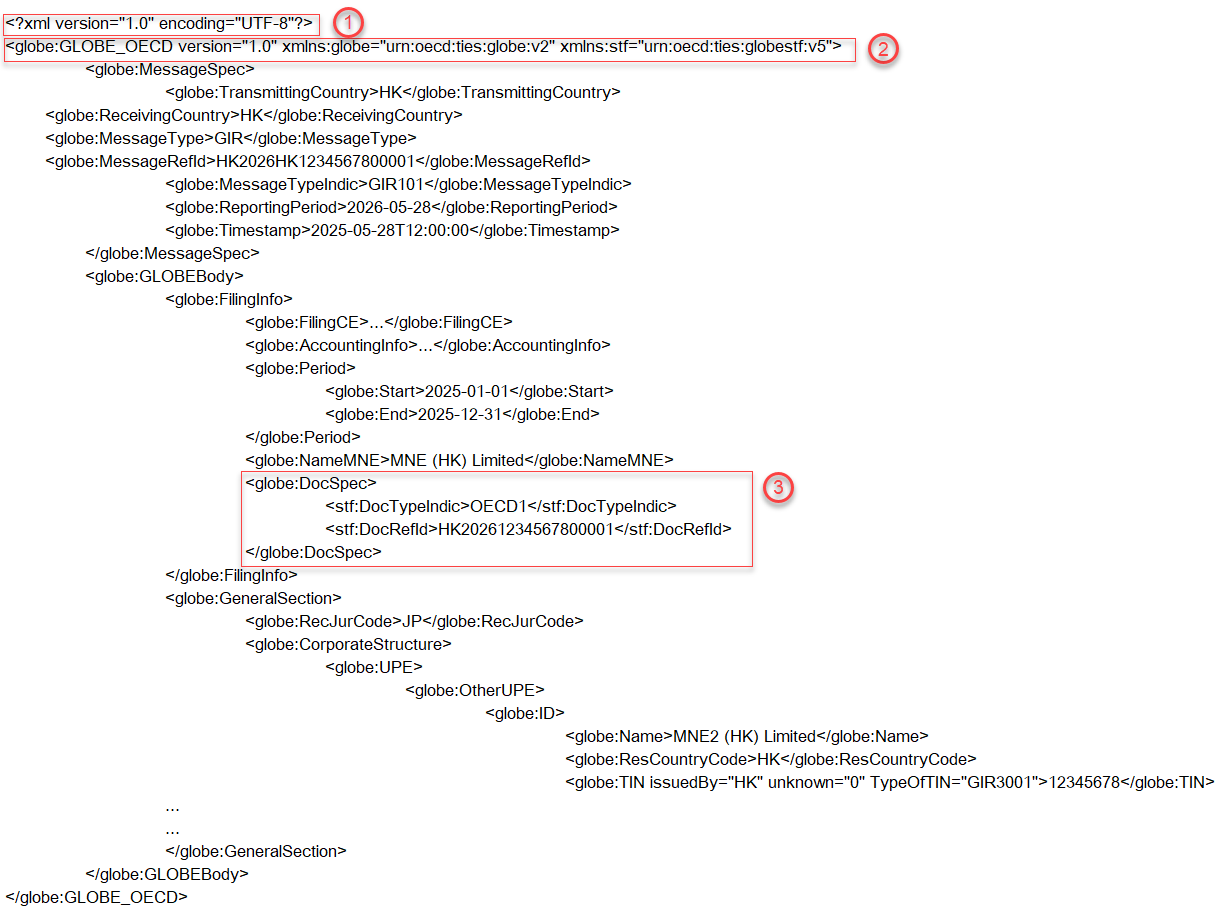
Common errors for Submit Test Data File / Manage Data File
70.
Q:
I have prepared an XML data file by using self-developed software. When I submit the test data file through the function "Submit Test Data File", it returns an error message "File contains production data for test environment. (PTP Code 50008) [E-0607]". What is the possible error in the data file?
A:
For submission of a test data file containing new information, the value of the MessageTypeIndic element should be GIR101 (i.e. the message only contains new information) and the value of the DocTypeIndic element should be OECD11 (i.e. New Test Data).
For submission of a test data file for correction of data, the value of the MessageTypeIndic element should be GIR102 (i.e. the message contains corrections for previously sent information) and the value of the DocTypeIndic element should be OECD12 (i.e. Corrected Test Data) and/or OECD13 (i.e. Deletion of Test Data).
Please note that a test data file can contain either new records (OECD11) or corrections (OECD12 / OECD13), but should not contain a mixture of both.
71.
Q:
“I have prepared an XML data file by using self-developed software. When I submit the data file through the function “Manage Data File”, it returns error message “File contains test data for production environment. (PTP Code 50009)[E-0608]”. What is the possible error in the data file?
A:
For submission of GIR data file containing new information into Pillar Two Portal through the function "Manage Data File", the value of the MessageTypeIndic element should be GIR101 (i.e. the message contains new information) and the value of the DocTypeIndic element should be OECD1 (i.e. New Data).